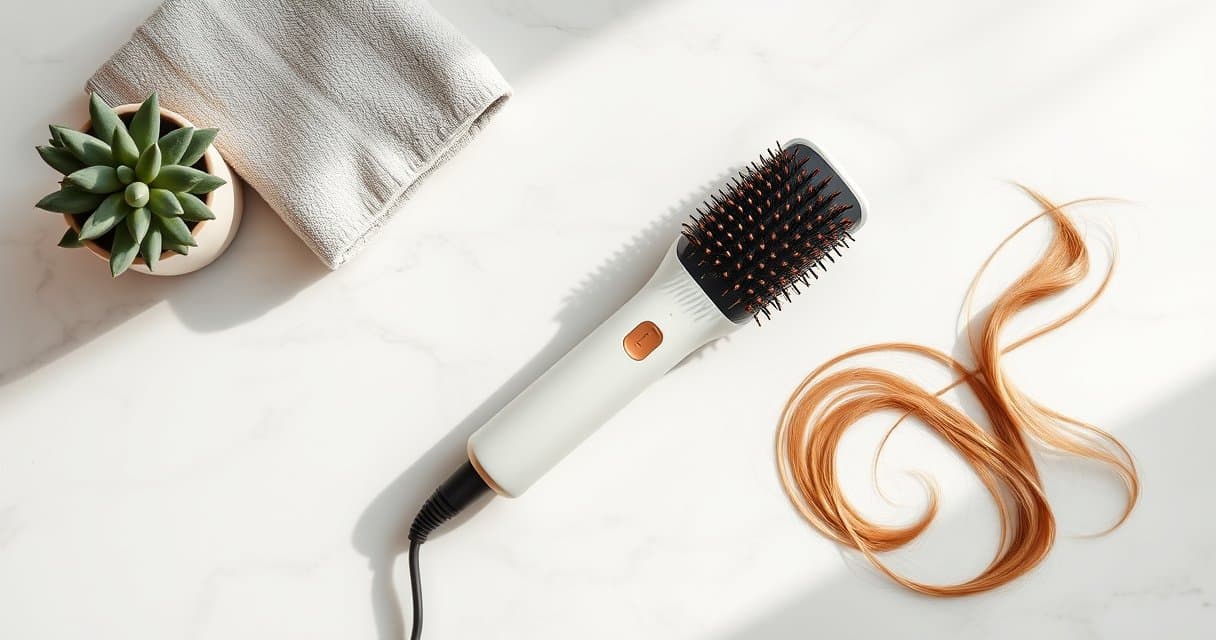
You dream of smooth, shiny hair, but your hairdryer and brush make you feel like you're taming a bush instead? The blow-dry brush is the game-changing ally you need. Say goodbye to exhausting styling sessions that require multiple tools. With a single motion, it dries, smoothes, and adds volume as if by magic. I'll explain everything so you can finally know if it's right for you.
Key Points to Remember
- The blow-dry brush combines drying and styling in one motion for a radical time saving and a professional result.
- The choice of model should be guided by your hair type (fine, thick, sensitive) and the desired result (volume, smoothing, shine).
- Good technique (pre-drying, fine sections, slow passes) is essential for a beautiful result without damaging the hair.
- Options like negative ions and protective materials (ceramic) genuinely improve the finish and limit damage.
- Regular maintenance and proper storage significantly extend the appliance's lifespan.
The Principle of the Hot Air Brush: How It Works and Benefits
Imagine this: your hair dryer in one hand, your round brush in the other, and that eternal struggle to synchronize the two without burning your fingers. The hot air brush solves this problem in one fell swoop. Its principle is ingeniously simple: it's a rotating brush (often round) that directly integrates a motor and a heating element. In a single device, you therefore hold a hair dryer and a styling brush. The hot air is blown from the center of the brush, through the bristles, directly onto the strand of hair that is wrapped around it. It is this fusion of the two tools that makes all the difference.
The Three Game-Changing Benefits
Drastic Time Saving. This is the first shock. You easily cut your styling time in half. No more need to dry your hair 80% before starting to brush it for smoothing. You start with towel-dried hair, and in one continuous pass, you dry and style it. For many, this means going from a 45-minute routine to 20 minutes max. A liberation!
Accessibility and Professional Results. Let's face it, achieving a perfect blowout with two separate tools requires a certain dexterity and practice. The hot air brush democratizes the technique. The strand is naturally caught and wrapped by the rotation of the bristles; you simply guide the appliance from the roots to the ends. The result? Ultra-shiny smoothing, lifted roots for volume, and ends that turn nicely inward. It's this "salon-style" result at home that is immediately appealing.
Less Damage to the Hair Fiber. This is a crucial point, often underestimated. With a classic hair dryer, we tend to overheat the same area by aiming directly at it, then pull hard with the brush to detangle and smooth. The hot air brush, however, diffuses heat more evenly onto the wrapped strand. The tension applied is also gentler and more constant. In the end, you get effective smoothing with, subjectively, less feeling of dryness and frizz afterward. It's a real plus for the health of your lengths in the long term.
Honestly, if you hate your hair routine or if your mornings are a marathon, this appliance is for you. It's not a gimmick. For fine to thick hair, straight to slightly wavy hair, it's often a revelation. On the other hand, for very curly or very dense coily hair, the technique can be less intuitive and require more skill to avoid tangling – it's important to mention that.
Choosing Your Model Based on Hair Type and Goals
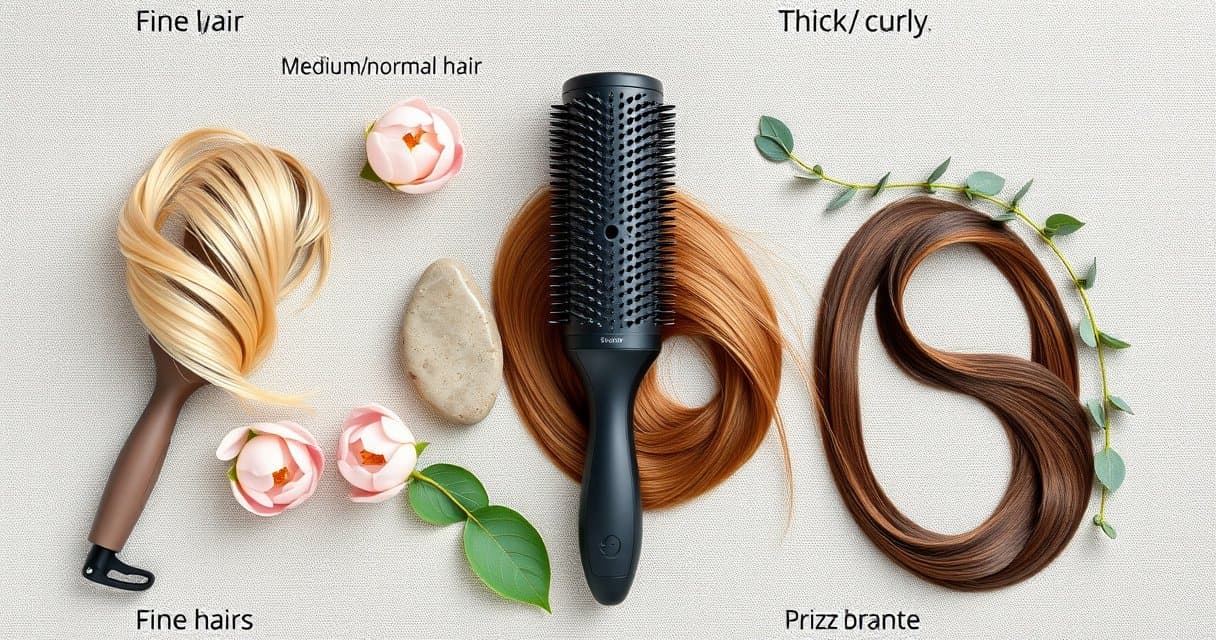
The trap would be to believe that one hot air brush suits everyone. That's false. Your choice should be guided by two things: the intrinsic nature of your hair (thickness, texture) and the result you're aiming for (perfectly smooth, root volume, simple detangling). Making the right choice here makes the difference between a tool that sleeps in a drawer and one that becomes indispensable.
For fine, flat, or volume-lacking hair
This is the ideal playing field. Your enemy? Lack of body and roots that stick to the scalp. You need a brush that will lift without weighing hair down. Opt for a model with a generous diameter – a 40 mm round brush, for example, will create more volume than a 30 mm one. The bristles should be relatively short and close together to grip fine strands well without letting them slip. A good heat level is necessary, but the air speed (the blowing power) is even more critical: it's what will lift the root and give that light, natural "bouffant" effect. Avoid brushes that are too heavy or with bristles that are too dense and long, as they would flatten your hair.
For thick, wavy, or unruly hair
Here, the challenge is different: you need power to tame the mass, penetrate the hair fiber, and tackle residual moisture. Motor power (in watts) becomes your number one criterion. Look for models advertised from 1000W, that's a good starting point. A brush with a medium diameter (35-40 mm) is often a good compromise: it allows you to wrap sufficiently thick sections without the session lasting hours. Also look for high-temperature options (up to 200°C) for the most resistant hair. For stubborn waves, an oval brush can be easier to maneuver on the lengths than perfectly round models.
For ultra-shiny straightening or a curved "blow-dry" effect
It's all in the shape of the bristles. If your Holy Grail is perfectly smooth, almost mirror-like hair, look for models with smooth ceramic bristles or ones coated with smooth nylon. They glide over the hair cuticle and smooth it deeply. For that effect of ends turning nicely inward like at the hairdresser, a classic round brush works perfectly. The trick? Choose a diameter suited to your hair length. The smaller the diameter (25-30 mm), the tighter and more defined the curl will be. The larger it is (50 mm and above), the more the effect will be a slight, wide, and natural movement, perfect for long hair.
For sensitive, colored, or damaged hair
Caution is required. You don't want a tool that will further damage your already fragile hair fiber. Temperature control is non-negotiable. You need a model with multiple heat settings, ideally a fixed "cool" setting to seal the cuticle at the end of the session. Technologies like negative ion emission are not a bluff here: they genuinely help reduce frizz and seal in hydration, for a softer, less flyaway finish. Absolute priority to gentle materials like ceramic or tourmaline which diffuse heat evenly, without aggressive hot spots.
Our Selection
Whether you want to save time in your hair routine or achieve a salon blowout at home, blow-dry brushes have become essential. Among the plethora of models, three names consistently come up: Revlon, BaByliss, and Remington. We've scrutinized the technical specifications and thousands of customer reviews to help you see things more clearly. Here is our comparative analysis of three leading models, each with its own philosophy.
| Product | Power | Technology | Included Attachments | Key Strengths |
|---|---|---|---|---|
| Revlon One-Step Volumiser Plus | 1100 W | Ionic Tourmaline & Ceramic | 1 fixed oval brush head | Fast drying, root volume, ease of use |
| BaByliss Multistyle Blower Brush | 1200 W | Ionic & Ceramic | 4 interchangeable brush heads | Extreme versatility, precise control, varied finishes |
| Remington Keratin Protect Rotary | 1000 W | Ceramic & Keratin | 3 brush heads (2 rotary) | Automatic rotation, fiber care, very long cable |
Revlon One-Step Volumiser Plus
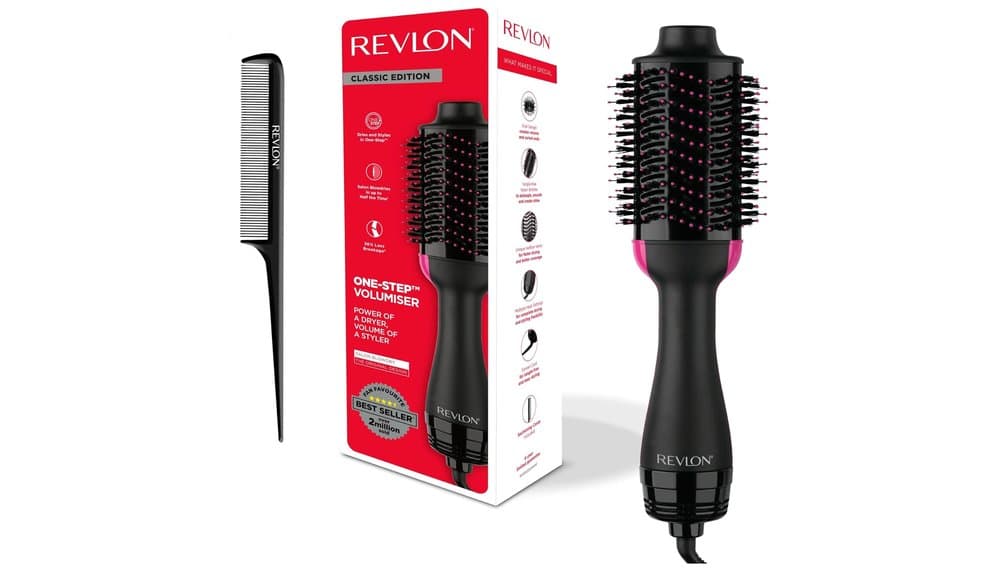
The Revlon One-Step Volumiser Plus is the evolution of a best-seller, designed for those who prioritize efficiency and simplicity. On paper, its specs promise a powerful (1100 W) 2-in-1 tool that combines drying and styling in one step, promising up to twice the speed.
The core feature of this tool is its fixed oval brush head, which is more compact than the original version according to the brand, designed to get close to the roots and create instant volume. Ionic tourmaline and ceramic coating technology aim to reduce frizz and protect the hair fiber. According to user feedback, this is where the tool truly shines: the community notes that it dries and smooths hair quickly, with a voluminous and shiny result, particularly appreciated on medium to long hair. Many highlight its ease of use, even for styling novices, and the significant time savings it provides.
However, this simplicity has its limits. The single, fixed head means you won't be able to create tight curls or precise waves; its primary role is volumizing straightening. Some reviews mention that the tool can feel a bit heavy (730g) during prolonged use, and that very thick or long hair may require multiple passes. Finally, although the motor is advertised as 40% more durable, some users report long-term durability issues, a point to consider.
BaByliss Multistyle Blower Brush
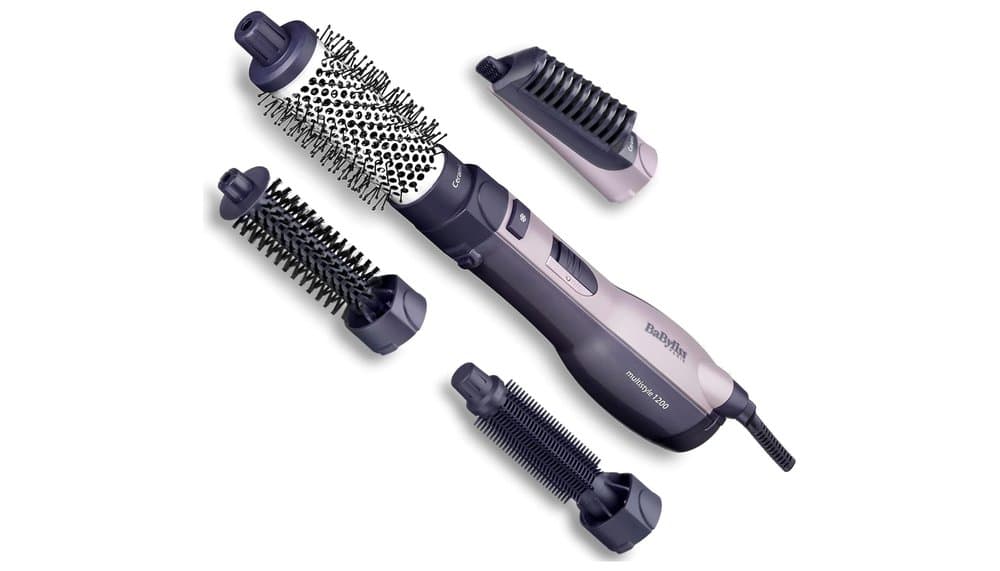
The BaByliss Multistyle positions itself as the tool for customizable styling. With its 1200 W of power and especially its four interchangeable brush heads, it promises to switch from a smooth blowout to defined curls in an instant. Versatility is its key feature.
The strength of this tool, based on reviews, lies in this complete toolkit. The 38 mm thermal brush structures the blowout, the 20 mm round brush allows for precise finishes, the 25 mm styler brush adds movement, and the smoothing head offers an ultra-smooth result. Users who like to change their style find it ideal. The three speed/heat settings combined offer highly appreciated control to adapt the heat to your hair texture. Ionic technology is also present to combat frizz.
The trade-offs for this versatility mainly concern the learning curve and setup time. Unlike the Revlon's "all-in-one" approach, you need to change heads here depending on the desired result, which can break the rhythm. Some feedback indicates the tool can seem less intuitive at first and that handling requires a bit of practice, especially with the smaller round brushes. Its weight is light (360g), but it's worth noting the noise level is sometimes mentioned in comments.
Remington Keratin Protect Rotary Blower Brush
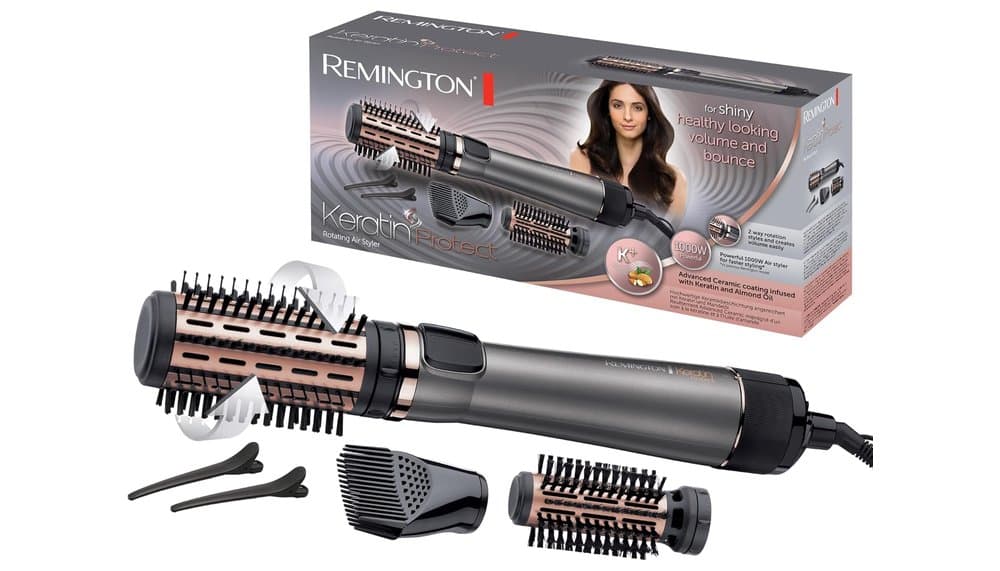
The Remington Keratin Protect focuses on care technology and an automatic mechanism to simplify blow-drying. Its main feature is its rotating brush head that turns automatically, promising to replicate a stylist's motion without you having to twist your wrist.
On paper, the tool features a ceramic coating enriched with keratin and almond oil, aiming to nourish hair during styling. With 1000 W of power and two rotating brush heads of different diameters (40 and 50 mm) plus a volumizing comb, it targets those seeking curls and root volume effortlessly. Customer reviews often praise the ease of achieving uniform, well-defined curls, even for the less skilled. The 3-meter rotating cable is also a very popular practical asset.
The limitations reported by the community revolve around adaptability. The automatic rotation can be surprising and requires an adjustment period; some users find it limits control compared to a fixed head. The 1000 W power, while sufficient, is sometimes considered a bit weak for drying very thick or very wet hair quickly, leading some to pre-dry their hair first. Finally, at 870g, it is the heaviest tool in this selection, a factor to consider for long sessions.
Technical Options to Decipher (Heat, Ions, Accessories)
Looking at the technical specifications of a hot air brush can be dizzying. Heat, ions, ceramic, tourmaline... is this real progress or just marketing? Let's separate fact from fiction, so you know where to put your money.
Heat Management: The Core Issue
This is the first point to check. Two things matter: the temperature range and its stability.
- Settings: A model with only 2 speeds and 2 temperatures is often too limiting. Look for one that offers at least 3 heat settings. For example: a low setting (around 120°C) for fine or damaged hair, a medium setting (160°C) for daily use, and a high setting (200°C) for thick or unruly hair. This flexibility is valuable.
- Stability: This is the crucial point few brands highlight. A good brush maintains a constant temperature, without surges that could burn your hair. Materials like ceramic or tourmaline help to diffuse heat evenly. An electronic thermostat is often a sign of better control than a simple mechanical button.
Ions, Ceramic, Tourmaline: The "Care" Kit
Don't expect a revolution, but a real improvement in the finish.
- Negative Ions: This is not a gimmick. Their role is simple: they neutralize positive electrical charges that make hair static and cause frizz. In practice, you'll get a smoother, shinier, and less "flyaway" finish, especially in humid weather. For me, this is a feature that has become almost indispensable.
- Ceramic vs. Tourmaline: These materials often coat the bristles or heating element. Ceramic diffuses gentle, even heat. Tourmaline, a crushed semi-precious stone, naturally emits negative ions when heated. Frankly, the difference between the two in use is minimal. The important thing is that the bristles are coated with one of these materials to protect the hair fiber, rather than being bare metal.
Accessories Worth It (And The Others)
Is the kit bursting at the seams? Be wary. One useful accessory is better than five useless ones.
- The Concentrator (or Focalizing Nozzle): This is the only accessory I consider essential on some models. This narrow nozzle clips onto the brush and channels the airflow. What for? To dry roots with precision without making the lengths fly away, or to work section by section on very defined fringes or outlines. If you like precise hairstyles, it's a must-have.
- Interchangeable Heads: Some brushes allow you to swap the round head for a smooth plate (like a straightener) or a volumizing brush. The idea is appealing, but in practice, you rarely use more than one head. Make sure the main head already meets 90% of your needs.
- Storage: An included wall mount or travel case is always a plus to prevent the cord from tangling in the drawer.
So, the best hot air brush technically? It's the one that combines precise heat control (at least 3 settings), ion emission, and protective material-coated bristles. The rest are bonuses that really depend on how you style your hair. Don't pay extra for options you'll never use.
Mastering Techniques for Styling Without Damage
Having a great hot air brush is one thing. Knowing how to use it without turning your ends into straw is another! Technique makes all the difference between a professional result and stressed-out hair. Follow the guide.
Preparation: The Forgotten (But Crucial) Step
Never use the brush on soaking wet hair. That's the best way to fry it and waste a lot of time.
- Always pre-dry with your regular hair dryer, 15-20 cm from the roots, until your hair is 80% damp. How to judge? It should no longer be dripping, but still feel cool and damp to the touch, strand by strand.
- Apply a heat protectant. Non-negotiable. A dab for fine hair, two for thick hair, from roots to ends. This is your shield against direct heat.
The Perfect Blow-Dry Technique
Forget frantic back-and-forth movements. The key is slowness and method.
- Work in sections. Tie up the top part of your hair and only release one thin section (no wider than the brush) at a time, starting at the nape of your neck. It's less daunting and much more effective.
- Tension the section, but without pulling. Hold the end of a section with your free hand to create slight tension. This allows the brush to glide easily and gently remove knots.
- The magic movement: Place the brush under the section, close to the scalp. Turn it on. Gently wrap the hair around the brush, then slowly slide down following the length, maintaining the tension. Count 8 to 10 seconds per pass. If the brush catches or pulls, you're going too fast or the section is too thick.
- Temperature and speed: Start with maximum heat and speed at the roots (for volume), then lower by one setting for the lengths, and use the lowest setting (or even cool) to seal the cuticle at the ends. This gradation protects the fiber where it is most fragile.
Pitfalls to Absolutely Avoid
- Don't linger on the same section. One pass, maximum two, otherwise you risk overheating. If a strand isn't perfect, let it cool down and go over it again later.
- Clean the bristles regularly. Residue from products and hair stuck on the brush prevents heat from dispersing properly and forces the appliance to work harder, often overheating. A quick brush cleaning after each use makes all the difference.
- Wait for the brush to cool down completely before storing it. Residual heat in a drawer is bad for the components and for your other belongings.
In the end, the best hot air brush in the world won't give you beautiful results if you handle it like a regular hair dryer. Take your time the first few times. Once you've mastered the technique, you'll style your hair in a flat 15 minutes, and your hair will thank you.
Maintenance Tips and Device Lifespan
You've invested in this hair dryer brush, and you want it to last for years. It's nothing magical, but a few habits make the difference between a device that gives up after 18 months and a faithful companion. Let's talk about maintenance and longevity.
Daily (and Deep) Cleaning
This is fundamental, and yet everyone neglects it. A dirty brush overheats, blows less powerfully, and styles less effectively.
- After each use: Turn off and unplug. Use the small tool provided (or an old toothbrush) to remove hair wrapped around the core and visible residue on the bristles. Two minutes, no more.
- The monthly deep clean: Now, we get serious. Mix a little warm water and two drops of mild dish soap in a bowl. Dip a microfiber cloth in this mixture, wring it out well, and gently wipe each bristle. For models with removable bristles, take the opportunity to soak them for 10 minutes. Most importantly, never fully immerse the device! A simple trickle of water into the motor and it's finished.
Where and How to Store It?
Frankly, leaving it lying around on the humid bathroom shelf or stuffing it in a drawer while pulling on the cord is a quick way to say goodbye.
- Let it cool down completely in the open air before storing it. Residual heat in a confined space damages electronic components and wire sheathing.
- Coil the cord loosely, making wide loops. Avoid sharp angles which eventually break the internal wires.
- The ideal solution? A fabric pouch or a box in a cupboard, away from constant dust and humidity.
The Telltale Signs (and What to Do)
Your device isn't eternal. Be attentive.
- The burning smell: If a persistent odor appears even after cleaning, it's often the motor or a component wearing out. This is a serious warning.
- Decreased performance: It takes twice as long to dry the same section of hair, the heat is irregular, the airflow weakens. This is a sign that the heating element or fan is nearing the end of its life.
- The cord heating up abnormally near the plug is a major red flag. Unplug immediately.
The best hair dryer brush is often the one that is well cared for. With this care, you can expect a lifespan of 3 to 5 years, or even more for high-end models. Think of it like any good electrical appliance: a little respect, and it will treat you well in return.
Conclusion
The blow-dry brush is not a gimmick. It is a true hair transformation tool.
Choose it carefully, according to your hair and your desires. Master its techniques. Take good care of it.
It will repay you daily, with time saved and beautiful hair. The ball is in your court.
Frequently Asked Questions
How to properly use a hot air brush without damaging hair?
Start by pre-drying your hair until it is 80% damp and apply a heat protectant, then work on fine sections, slowly guiding the brush downward, taking about ten seconds per pass. Absolutely avoid using it on soaking wet hair and do not repeat passes on the same warm section to prevent damage.
Which hot air brush to choose for thick hair?
Opt for a powerful hot air brush with a high heat setting (up to 200°C) and multiple airflow speeds for efficient drying. A model with negative ions and ceramic pins will help tame frizz while limiting thermal damage.
Are ions in a hot air brush useful?
Yes, negative ions are useful because they neutralize positive electrical charges, which reduces frizz and gives a smoother, shinier finish. They are particularly beneficial for dry hair or in humid weather.
How to clean a hot air brush?
After each use, remove any trapped hair with a small tool, and once a month, clean the pins with a damp cloth and mild soap without ever submerging the device. Regular cleaning prevents overheating and maintains performance.
What is the lifespan of a hot air brush?
A well-maintained hot air brush can last 3 to 5 years, or even longer for high-end models. Signs of the end of its life include a persistent burning smell, a significant drop in performance, or an abnormally heating cord.
Is the hot air brush suitable for fine hair?
Yes, it is very suitable for fine hair, provided you choose a model with a generous diameter to create volume and a gentle heat setting to avoid stressing it. The key is to use a low temperature (around 120°C) to prevent breakage.
Free content, no sponsors — Our editorial process is fully independent and receives no brand funding. Some links are affiliate links: if you purchase through them, we earn a small fee, at no additional cost to you.
Guides you might like
Automatic Loopers: Buying Guide
Get effortless, long-lasting curls. Our guide helps you choose the right automatic curling iron for your hair type and perfect results.
Curling Short Hair
Rediscover your short hair! Learn how a curling iron sculpts your cut, adds movement, and defines curls with the right technique and barrel size.
Curly Hair Masks: Buying Guide
Transform your curl routine. Discover how a hydrating curl mask deeply nourishes, defines, and tames frizz for effortless, beautiful curls.
Articles you might like
Parlux Supercompact 3500 Hair Dryer Review and Test
Powerful Parlux Supercompact 3500 hair dryer review: Professional ionic & ceramic performance for fast, healthy drying on all hair types.
Remington S6505 Sleek&Curl 2-in-1 Hair Straightener Review
Review: Does the Remington S6505 2-in-1 straightener and curler protect hair health while performing well on all hair types?
BESTOPE PRO 6 in 1 Curling Iron Set Review
Try six curl styles with one tool. Review examines the BESTOPE PRO set for effectiveness, hair health impact, and suitability for different hair types.