Do you spend a ton of time under the hair dryer, but your hair stays dull, frizzy, or lacks volume? This is often a sign that a basic model is no longer enough. Switching to a professional hair dryer completely changes the game, but with all the technologies and promises, it's easy to feel lost. I will help you see clearly to make the right choice, without breaking the bank.
Key Points to Remember
- A professional AC motor is more efficient and durable than a basic DC motor, as it dries with a powerful airflow rather than aggressive heat.
- Negative ions and ceramic/tourmaline reduce frizz and protect hair by offering faster, less hot drying.
- Balance and noise level are as important as power for daily comfort of use.
- The right accessories, like a quality diffuser or round brush, transform the tool into a custom styling instrument.
- A long warranty (3-5 years) and simple maintenance (filter cleaning) are essential to protect your investment in the long term.
The Engine and Power: The Heart of the Device
This is the fundamental difference between an entry-level hair dryer and a true professional model. Here, we're not just talking about watts, but the type of motor. This is what will determine the speed, efficiency, and longevity of your device.
AC Motor vs. DC Motor: A Matter of Airflow
The vast majority of consumer hair dryers use a Direct Current (DC) motor. It's compact and inexpensive, but it heats up quickly and loses power over time. For intensive use, it wears out. The Alternating Current (AC) motor, on the other hand, is the cornerstone of professional models. More robust, it generates a much more powerful and constant airflow without overheating. The result? It dries hair by the force of the air and not by excessive heat that damages it. This is what preserves their integrity.
Power: Beyond the Marketing Number
You often see "2000W" in large print on the box. It's an indicator, but it can be misleading. These watts mainly indicate the heating element's consumption. What really matters is the useful power: the combination of a high-performance AC motor and optimized airflow. A pro model with a good AC motor and 1600W will often be more effective and gentler than a basic 2200W model with a weak, noisy DC motor. Frankly, be wary of exaggerated numbers; it's often just hot air.
To see clearly, here is what these differences mean in practice:
| Characteristic | DC Motor (Common Models) | AC Motor (Professional Models) |
|---|---|---|
| Airflow | Moderate, can weaken | Powerful, constant, and targeted |
| Noise Level | Often high-pitched and shrill | Deeper, more profound airflow sound |
| Lifespan | 2 to 5 years with regular use | Can last 10 years and more |
| Impact on Hair | Often dries through intense heat | Dries mostly through powerful air |
Speed and Heat: Control is Key
Two switches are a minimum. But a better professional hair dryer offers you real control. Look for models with at least two airflow speeds (low/high) and three, or even four, temperature settings (cool, warm, hot, very hot). This granularity is precious. For example, the "warm/high" setting is perfect for defining curls without frizzing them, while "cool/low" allows you to set the style at the end of drying. An instant cold shot button is essential; it's what seals the hair cuticle for a shiny finish.
How Technologies Act on Your Hair
Once the motor does its job of blowing air, that's where the technologies come into play to transform the hot air into care. They are not there to look pretty on the box, but to address very specific hair issues. You stop cooking your hair, you start styling it.
Negative Ions: Your Allies Against Frizz
This is the most widespread technology, and for good reason. A hairdryer emits negative ions which break down water molecules on the surface of the hair. In short, water penetrates faster inside the fiber rather than staying on the surface and creating frizz as it dries. The result is tangible: drying up to 30% faster (that's time saved in the morning!) and a smooth, compact, and shiny finish. If you have thick, curly, or porous hair, it's a game-changer. For me, it has become a non-negotiable criterion.
Ceramic and Tourmaline: Gentle and Even Heat
Often paired together, these two materials make a difference in heat quality.
- Ceramic (and its derivative, infrared) diffuses gentle and even heat. It avoids hotspots that damage the cuticle. Imagine a convection oven that bakes a cake perfectly, without burnt spots. It's the same principle.
- Tourmaline, a crushed semi-precious stone, is often integrated into the grills or internal coating. It emits a large amount of negative ions when heated, thus enhancing the anti-frizz effect. It also adds a feeling of softness to the touch.
An appliance that combines the two is often a guarantee of respectful drying. This is what makes a better professional hairdryer for fine or color-treated hair, which are very sensitive to aggressive heat.
The Steam Function: The Secret to Defined Curls and Volume
Less common but brilliant, the steam function deserves attention. It emits micro-droplets of cold water integrated into the flow of hot air. What is it for? It hydrates the fiber deeply during drying. For curly or coily hair, it's magic: it allows redefining curls without weighing them down, avoiding a "straw-like" effect. For straight hair that lacks volume at the roots, a bit of steam at the roots followed by a shot of cold air gives an incredible boost. It's a very targeted technology, but if it's your need, it changes everything.
My opinion? Don't be dazzled by a long list of technologies. Identify your main problem (frizz, sensitivity, curl definition) and choose the technology that addresses it directly. A good AC motor with ceramic and ions will already work wonders for most of you.
Our Selection
Choosing a new hair dryer can be a real puzzle, balancing power, accessories, and promised technologies. To help you see more clearly, we have analyzed three models that stand out, based on their technical specifications and feedback from thousands of users. The goal: decipher what makes them strong and their limits to help you find the one that fits your needs.
| Product | Power | Weight | Key Technology | Included Accessories |
|---|---|---|---|---|
| GRT PRO 8800 | 3500W | 850 g | Negative Ions, Infrared, AC Motor | 2 concentrator nozzles, 1 diffuser |
| Remington AC9096 Pro Silk | 2400W | 1.04 kg | Ions, Ceramic + Silk Proteins, AC Motor | 1 7mm concentrator nozzle, 1 diffuser |
| Remington D5707 | 2200W | 850 g | Ions, Ceramic Grille | 1 unique curved nozzle, 1 XL nozzle, 1 diffuser, 1 round brush |
GRT PRO 8800
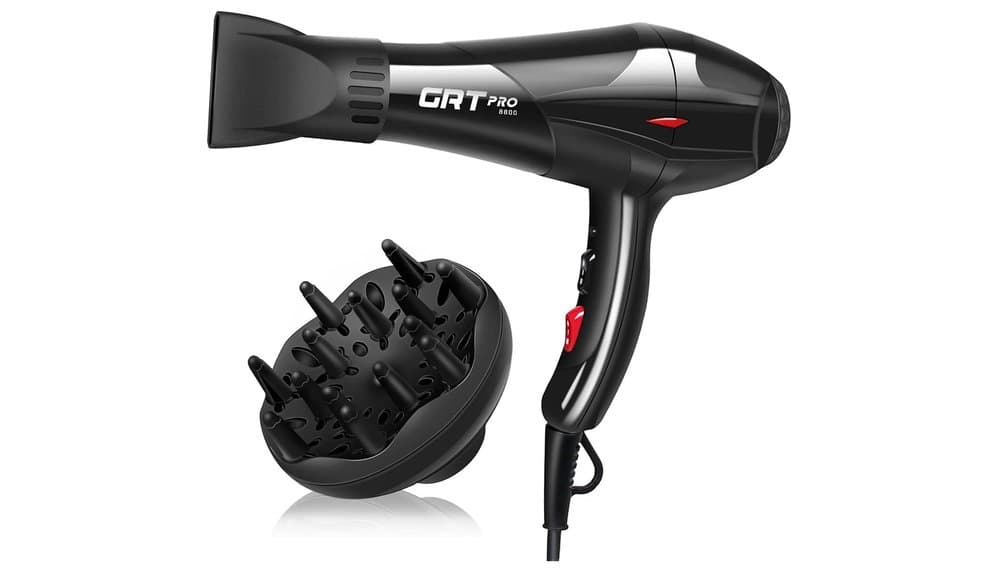
The GRT PRO 8800 clearly positions itself in the realm of extreme power. On paper, its 3500 watts and AC motor promise ultra-fast drying, which is confirmed by many reviews. Users indeed highlight its ability to dry long, thick hair in record time. Technology-wise, it relies on a combo of negative ions, blue light, and infrared to fight frizz, "repair" damaged hair, and soothe the scalp. According to feedback, hair does indeed come out smoother and shinier, with less static electricity.
Its design also seems thought out for intensive or family use: a 2.5-meter cable is highly appreciated for freedom of movement, and the integrated hook facilitates storage. Overheat protection is a reassuring safety point. However, this power has a downside. Its weight of 850 grams is noted by some users as a drawback for long drying sessions or if you have weak arms. Furthermore, while the power is there, some reviews note that the noise level is significant, which can be a factor to consider. Finally, despite the "anti-hair loss" promises, this is a claim that is difficult to verify for a simple hair dryer and should be taken with a grain of salt.
Remington AC9096 Pro Silk
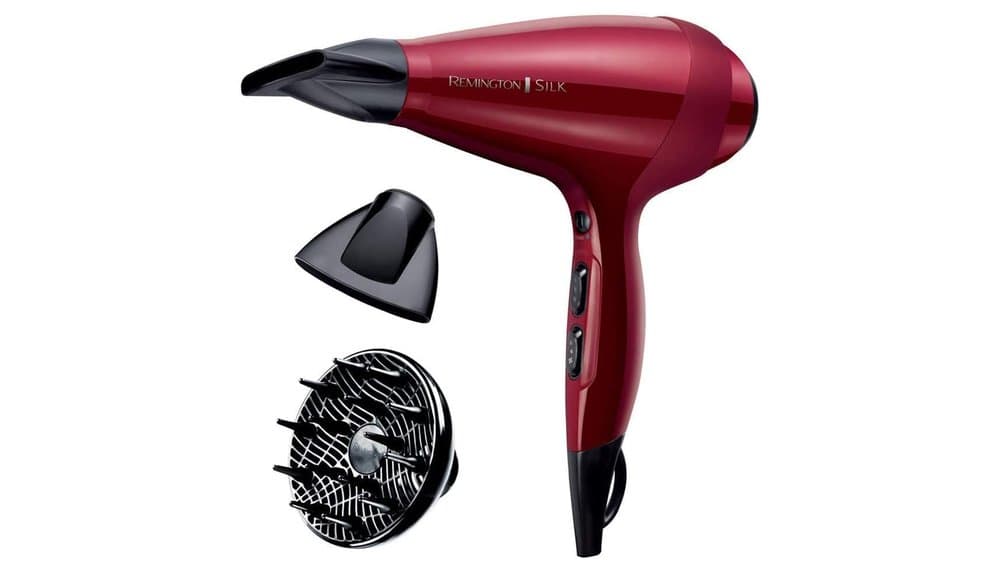
With the Remington AC9096 Pro Silk, we leave the race for raw power behind and enter the domain of care. Its flagship technology is its ceramic ring enriched with silk proteins, coupled with an ion generator. The promise is twofold: effective drying (2400W) and softer, shinier hair. The user community largely validates this promise, noting that hair is indeed less dry and more silky after use, even regularly.
The Turbo function, which increases airflow by 10%, is often cited as a real plus for speeding up drying without increasing heat. Like the GRT PRO, it is equipped with an AC motor, a sign of durability for daily use. However, its main weakness, according to feedback, is its weight. At over a kilogram, it is perceived as heavy and bulky by many users, which can make styling (blow-drying) tiring. Another limitation: it only comes with one standard concentrator nozzle. While this is sufficient for most uses, enthusiasts of very precise styling might find this limiting compared to other better-equipped models.
Remington D5707
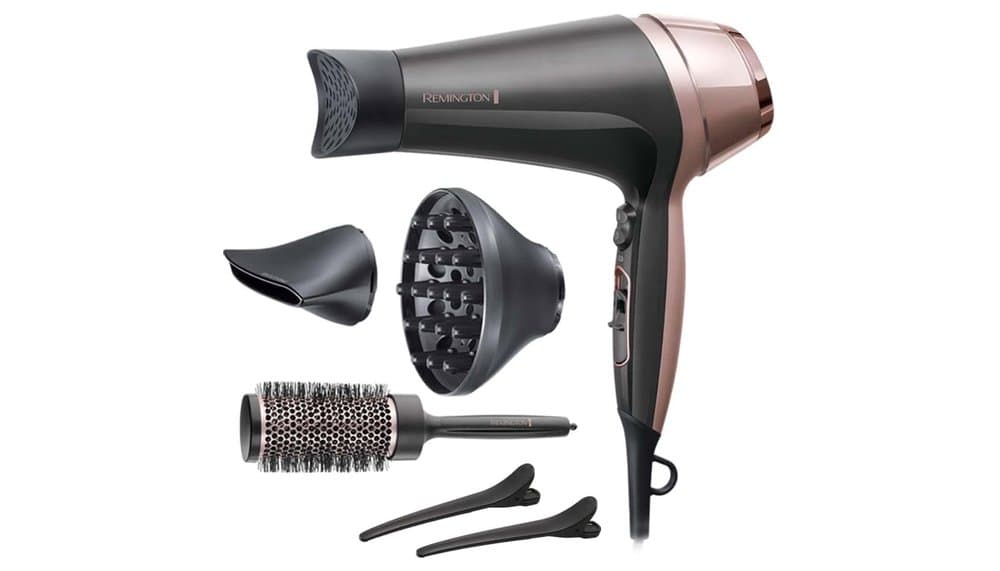
The Remington D5707 bets everything on versatility and styling. It is the only one in our selection to include a 45mm round brush in addition to traditional accessories (nozzle, diffuser). But its true particularity is its unique curved concentrator, designed to fit perfectly with the brush and distribute heat evenly. According to customer reviews, this set is very effective for creating natural-looking waves and curls directly with the hair dryer, without needing an additional tool.
With a power of 2200W and an airflow of 90 km/h, it is the least powerful of the three, but feedback indicates it is largely sufficient for daily family use. Its weight of 850g makes it quite maneuverable. Remington's standard ionic technology is present to limit frizz. The point of caution concerns this very versatility: some users report that the finish quality of the plastic accessories (notably the brush) can seem lightweight, although functional. It's a choice that bets on the quantity of accessories for a controlled budget. Furthermore, for those looking for ultra-fast drying on very thick hair, the lower power could be a limitation.
Choosing the Right Accessories for Your Routine
This is often the major difference between a basic blow-dry and real hairstyling work. Accessories are not useless gadgets. They are precision tools that transform hot air into a customized result. Frankly, an excellent professional hairdryer should come with solid ones, otherwise you're missing its potential.
The Diffuser: Much More Than an Accessory for Curls
Don't confine it to curly hair! A good diffuser, with long and flexible prongs, serves to preserve any natural texture. It diffuses air gently and evenly, without aggressing the strands. For curls, it avoids the dreaded "frizz effect" and defines curls with volume. For fine hair, it allows you to add body at the root without flattening the lengths. The trick? Dry on medium power and temperature while gently lifting the roots with the prongs. Result: hair full of life, not crushed.
The Concentrator: Your Precision Brush
The narrow nozzle, often included, is essential for any smooth or styled look. Its function is to channel the airflow onto a precise area. It's what allows you to "smooth" the cuticle for intense shine, work on a rebellious strand, or create waves by directing the airflow. Choose one with a fairly wide opening (4 to 5 cm) and rounded edges in metal or ceramic: it will glide through the hair better and distribute heat more evenly than an all-plastic model.
See priceThe Round Brush: The Versatile Tool for Volume and Smoothing
Here, quality is paramount. A pro round brush will have soft nylon bristles that don't pull and an ergonomic handle that doesn't get hot. The diameter determines the effect: 40-55 mm for volume and soft waves, 65 mm and more for powerful smoothing with curve. The trick for long-lasting volume? Wrap the strand around the brush, place the concentrator directly on the hair to heat it, then let it cool completely before unwinding. It's the thermal shock that sets the shape.
My advice: before buying, check the attachment quality of these accessories. They should snap on solidly, without any play. If they vibrate or seem fragile, it's a bad sign for the durability of the whole unit. The best models offer you a real toolkit for a custom routine.
Weight, Handling, and Noise Level
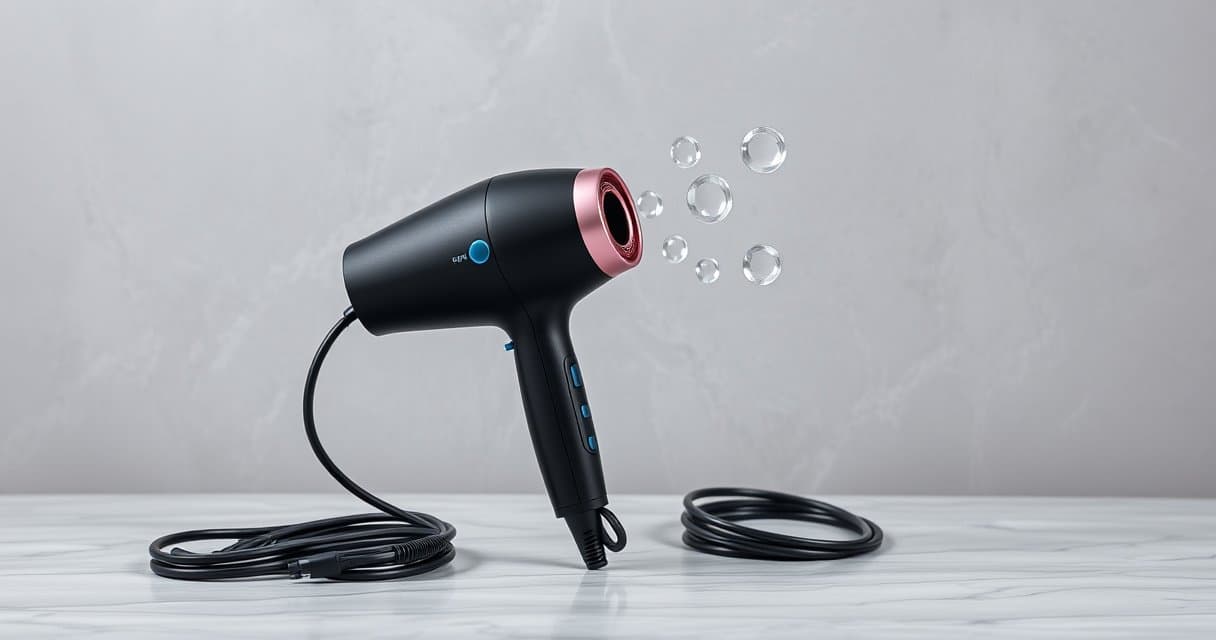
We rarely think of it first, but it is precisely what will determine whether you use your hair dryer with pleasure or leave it in the cupboard after two weeks. An appliance that is too heavy or poorly balanced guarantees a sore shoulder during long drying sessions. A shrill noise is real torture for the ears, morning or night. These aspects make all the difference between a tool and a routine companion.
Ergonomics: A Question of Balance, Not Just Grams
The weight announced on the box (often between 500g and 900g for professional models) doesn't tell the whole story. A well-balanced 700g hair dryer, with its center of gravity placed near the hand, will feel lighter and more manageable than a 600g model where all the weight is at the front. To test it virtually, look at the shape: a relatively compact body with the motor positioned near the handle is often a good indicator. The quality of the cord also matters – a stiff 1.5-meter cord will handicap you, while a flexible and long cord (2m or more) offers valuable freedom of movement.
Noise: The Forgotten Criterion of Daily Comfort
A professional AC motor is naturally more powerful and therefore often noisier than a low-end small DC motor. But the quality of construction plays a huge role. Some models incorporate soundproofing technologies or better-designed ventilation grilles to attenuate the high-pitched and shrill frequencies, which are the most unpleasant. We often talk about decibels (dB), but without a reference it's abstract. To give you an idea, a quiet hair dryer will run around 75-80 dB, while a standard model easily exceeds 90 dB. The difference to the ear is colossal, especially if you have children sleeping nearby or if you hate that morning buzzing.
My opinion? Don't sacrifice this aspect. You can find the best professional hair dryer in terms of performance, but if its noise gives you a migraine and its weight exhausts you, you won't use it to its full potential. Virtually "hold it in your hand" by reading reviews about the balance, and listen to demonstration videos to get an idea of the sound. Your physical comfort during the 10 to 30 minutes of drying is as important as the final result on your hair.
Warranty, Reliability, and Daily Maintenance
This is the less glamorous part, I'll grant you that. But it's what separates a wise purchase from a money pit. You're investing in a professional tool; it should last for years, not months. And for that, you need to look beyond the shine and the power.
The Warranty: Your Insurance Policy
A 2-year warranty is the absolute minimum. But frankly, for a pro device, you should aim for a 3 to 5-year warranty. This tells you more about the manufacturer than any marketing claim: they are the ones putting their hand in the fire for the durability of their components. Always read the fine print! Some warranties are "commercial" (everything is covered, labor included), others are "manufacturer's" (you only pay for labor). A big difference. Another crucial point: the warranty is often conditional on using the device with a properly grounded electrical circuit and the correct voltage. Plugging a 230V device into 110V? Goodbye warranty.
Telltale Signs of Reliability
The best professional hair dryer isn't just the one that dries quickly, but the one that will still work perfectly in 5 years. Two elements are good indicators. First, the availability of spare parts. The filters (at the back of the dryer) are consumables; they must be easy to order and replace without having to send the device to customer service for a month. Second, the design itself: a speed or temperature button with a firm, solid "click" will last longer than a fragile little plastic switch. The quality of the finish is a clue, not a frivolity.
Maintenance: 2 Minutes a Week to Extend Its Life
The main cause of failure? Overheating due to a filter clogged with dust and hair residue. It's simple, concrete, and avoidable. Vacuum the rear grill once a week, or use a small brush. This is the number one thing to do. Then, always let the device cool down for a few minutes on the lowest speed before storing it – cutting power to a hot motor stresses it unnecessarily. For storage, avoid winding the cord too tightly around the hot device, as this damages the internal wires in the long run. These simple habits preserve your investment far more than you might imagine.
Conclusion
Choosing a professional hair dryer is making a real choice for your hair and your time. It is not an insignificant purchase.
Do not be swayed by the first argument you come across. Think about your routine, your hair type, the feel in your hand. The watts, the ions, the accessories… everything must serve your result.
The right model is the one that saves you time while protecting your hair fiber. It becomes a trusted partner, day after day.
Take this advice, make your choice consciously. Your hair will thank you.
Frequently Asked Questions
What is the difference between an AC and DC motor in a hair dryer?
An AC motor, typical of professional models, produces a powerful and constant airflow without overheating, while a DC motor, common in consumer appliances, heats up quickly and can lose power.
What is the purpose of negative ions in a hair dryer?
Negative ions break down water molecules for drying up to 30% faster and reduce frizz by providing a smooth and shiny finish.
How to choose the power of a professional hair dryer?
Prioritize the combination of a high-performance AC motor and optimized airflow over marketing watts; a 1600W pro model with a good motor is often more effective than a basic 2200W model.
Why are weight and ergonomics important for a hair dryer?
The balance of the appliance is more crucial than its weight alone, as a center of gravity placed near the hand prevents fatigue during long drying sessions.
Which accessory should be used to dry curly hair without damaging it?
A diffuser with long, flexible prongs is essential for gently drying curly hair, defining curls, and avoiding the "frizzy" effect.
What warranty should you aim for with a professional hair dryer?
Opt for a 3 to 5 year warranty, which is a good indicator of the manufacturer's confidence in the durability of the appliance's components.
Free content, no sponsors — Our editorial process is fully independent and receives no brand funding. Some links are affiliate links: if you purchase through them, we earn a small fee, at no additional cost to you.
Guides you might like
Automatic Loopers: Buying Guide
Get effortless, long-lasting curls. Our guide helps you choose the right automatic curling iron for your hair type and perfect results.
Curling Short Hair
Rediscover your short hair! Learn how a curling iron sculpts your cut, adds movement, and defines curls with the right technique and barrel size.
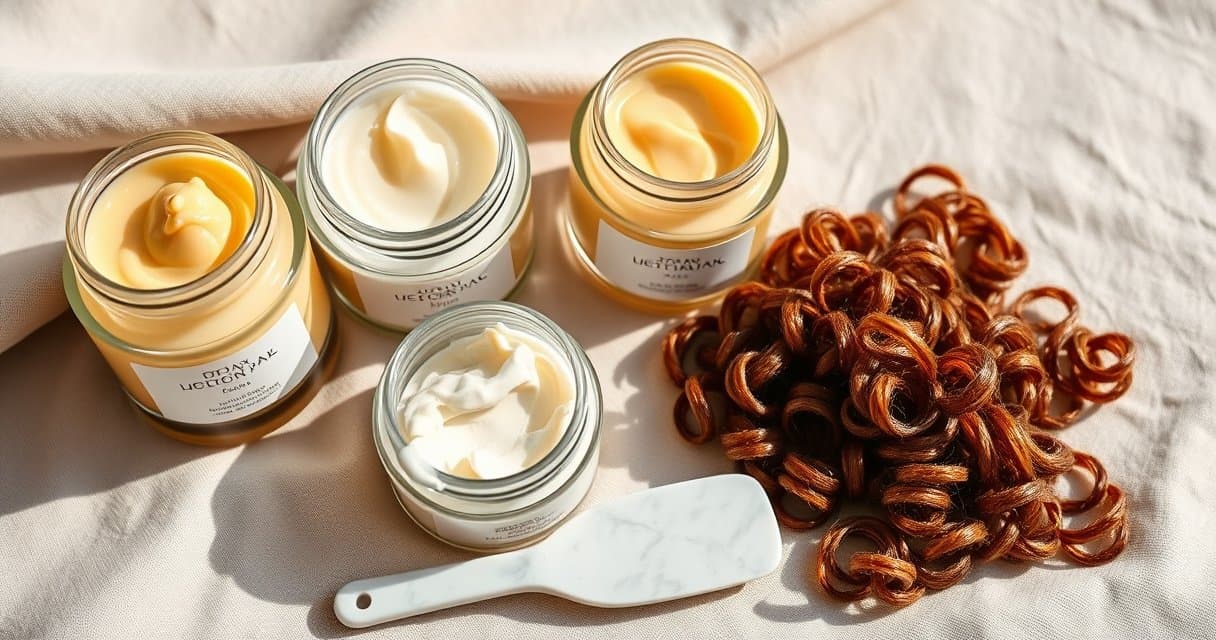
Curly Hair Masks: Buying Guide
Transform your curl routine. Discover how a hydrating curl mask deeply nourishes, defines, and tames frizz for effortless, beautiful curls.
Articles you might like
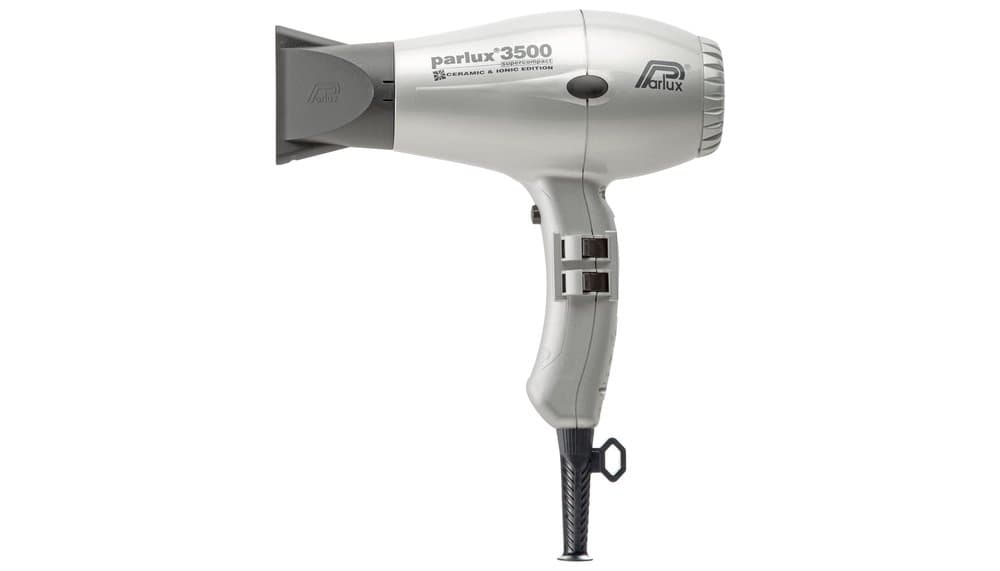
Parlux Supercompact 3500 Hair Dryer Review and Test
Powerful Parlux Supercompact 3500 hair dryer review: Professional ionic & ceramic performance for fast, healthy drying on all hair types.
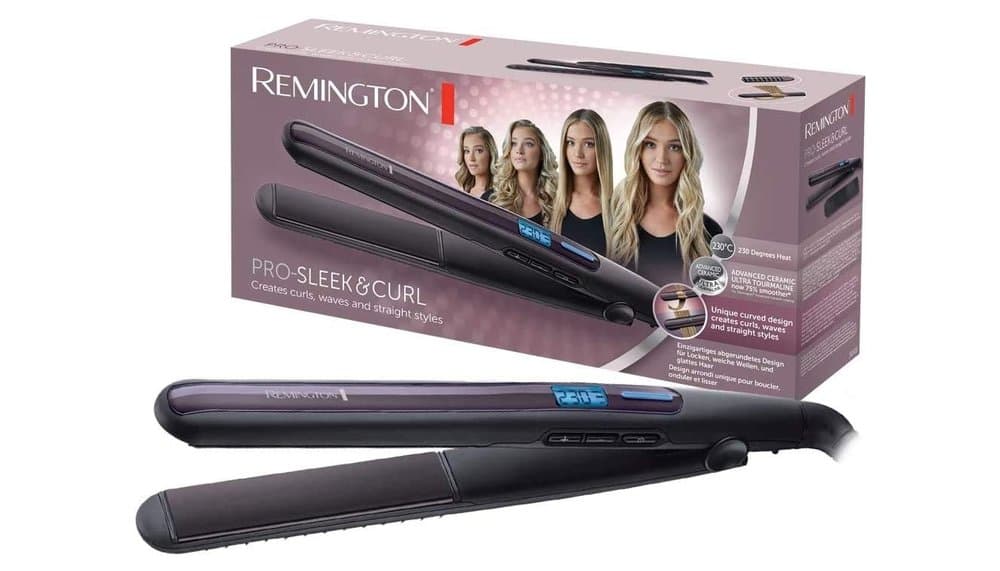
Remington S6505 Sleek&Curl 2-in-1 Hair Straightener Review
Review: Does the Remington S6505 2-in-1 straightener and curler protect hair health while performing well on all hair types?
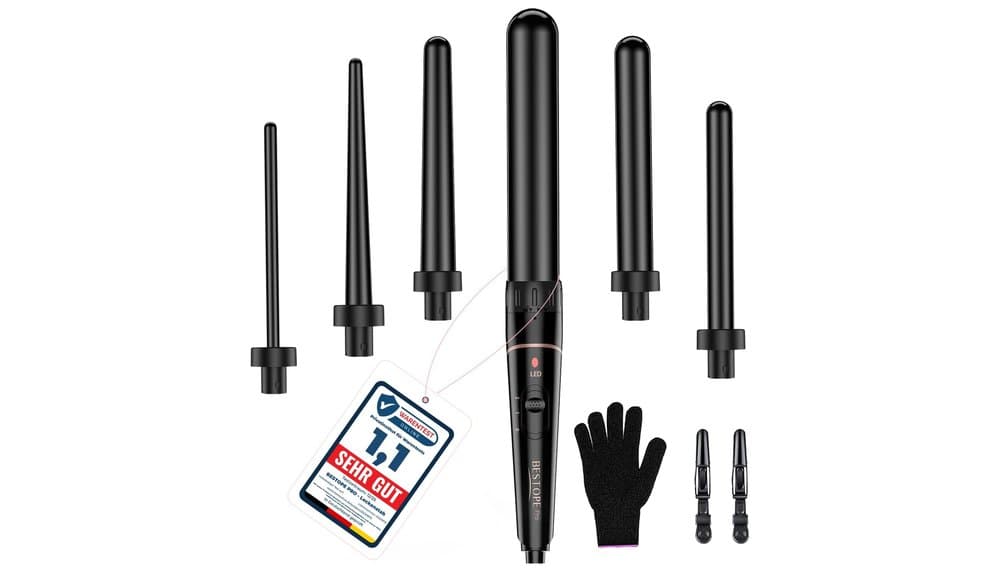
BESTOPE PRO 6 in 1 Curling Iron Set Review
Try six curl styles with one tool. Review examines the BESTOPE PRO set for effectiveness, hair health impact, and suitability for different hair types.